Merit Increase in a self-managed group. Experiment 2: Most Complete Employee

If you read our Experiment 1 for the merit increase, you would know that the system, even though it brought a lot of good things to the group, it had some room for improvement.

With a little bit more time we decided to work on an improved version of the “Best Employee” and we created the “Most Complete Employee”.

Very similar format to the previous voting but this time we made a few changed to cover some of the feedback shared by the employees:

Categories

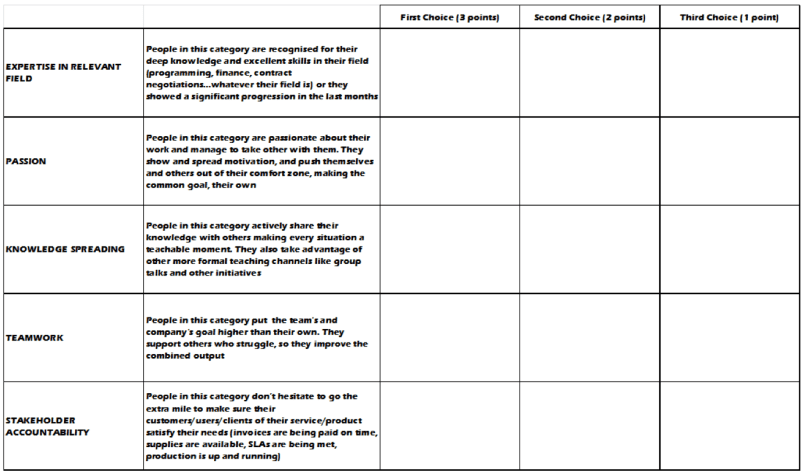
With the help of everyone, we defined 5 different categories: Teamwork, Stakeholder Accountability, Knowledge Spreading, Passion and Expertise in Relevant Field.
toprowers.png

With this, we intend to provide clear guidelines for the behaviour we want to reward, as well as shaping our culture at the same time.

Up to 15 different people

Although you could leave blanks and vote for the same person in different categories, having the possibility to vote for 15 different people would allow to include more profiles and recognise different aspects, like those teammates that aren’t rockstar programmers but great team players.

Public

Votes wouldn’t be anonymous. Everybody would see who voted for whom. Employees could still vote for themselves but everyone would see it. This would increase transparency and trust in the system and end results.

Online Survey

Instead of ballots and a box, we would use an online survey, this way we would avoid bad handwriting, human errors when counting and made easier to draw all sorts of statistics. The fact that all entries were 100% public made any tampering with this system very difficult.

Regatta System

Final results were based on the “regatta system”. This system rewards those who rather than scoring very high on a single category, scored nicely in several or all categories, showing that this employee was embracing the company values.

How it works:

  • As in the previous system, 3 names are entered for each category, the 1st name gets 3 votes, the 2nd gets 2 votes and the 3rd gets 1.
  • After the count, each category is sorted by highest number of votes, leaving everyone with a ranking position in each category. The one with more votes gets position 1, the second most gets position 2, etc.
  • Once you have all 5 categories ranked, you convert the ranking position into points. The 1st position would give you 1 point, second 2, third 3, etc. For example, if somebody is ranked 1st in Expertise, 9th in Knowledge Sharing, 22nd in Teamwork, 38th in Stakeholder accountability and 3rd in Passion, the total score for that person would be 1+9+22+38+3 = 73 points.
  • Finally, you put everyone in a single ranking and sort from least to most points. Those who got good positions on every category would be at the top of the ranking.

To illustrate it better, here a more complete example:

regatta1

Those 3 tables represent 3 different categories, sorted by the number of votes received by each employee. Then based on their position in the rank, they get that number of points from each category. Once you add up the points from each category you end up with a consolidated final score that we sort from lowest to highest.
regatta2

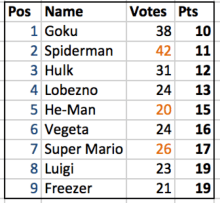
In the final ranking, you can see how Goku ended up first, even though he has fewer votes than Spiderman. The regatta system rewards Goku for scoring high in several categories. Even though Spiderman is the best in category 1, is not as good in categories 2 and 3.

Again, we ran a retrospective after this exercise and these are some things that came up:

What worked

  • People liked the categories, they represent the values of the office and they allowed to recognise different skills and profiles as well as a more homogeneous criterion.
  • Transparency was appreciated and even some voting was commented or challenged which helped shape a common understanding of the behaviour and aspects that we want to reward in our office.
  • It was great to have the opportunity to recognise a lot of different people.
  • People were mostly happy with the results and recognised that in such system people who deserve recognition make it to the top and vice-versa.

What didn’t work so well

  • People working with many different departments, such as a Product Owner, are more exposed and in a better position to be known and be evaluated by others, on the other hand, people working in teams like sales or finance are less likely to be recognised by others, since they work more isolated and often out of the office.
  • Same as in the previous method, all feedback is positive, employees don’t get feedback on what to improve and have to use alternative methods for this. This is especially rough for the only person that didn’t get any vote.
  • Again, this system is somehow time-consuming, involving everyone in the office which makes it heavy and not spontaneous. As shared before is less than ideal to run this only once or twice a year. Recognition is always better right after the fact and is hard to think of events that happened several months ago. We tend to unconsciously focus on more recent interactions with other people.


In conclusion, this method was much better than Experiment 1, we covered some of the gaps and improved significantly. Having to stick to the annual performance review, this is way much better and it allows you to progressively introduce more drastic practices while learning and shaping your culture in the process. For us, the results were no worse, if not better, than the traditional system and on top of that, we engaged everyone in one of the most sensitive decisions, showing trust and continuing in our journey towards more autonomy and self-management.

For the next iteration, we decided to spice things up a bit. Check out the Merit Increase in a self-managed group. Experiment 3: Salary Distribution.


Merit Increase in a self-managed group. Experiment 1: Best Employee

We did it, we removed hierarchy and managers, we are now all equal. Great.

However, as you may already know, most content in this blog refers to a self-managed office within the context of a bigger, hierarchical organisation, our self-management can only get so far, but still, pretty fun.

Before we realise, is that time of the year when the “bigger company” asks us to submit our proposals for promotions and salary increases. There used to be a clear step-by-step process for this, centralised through the managers. With no managers, what do we do now?

To be honest, we didn’t pay much attention to this and caught us by surprise, the deadline was around the corner and we had to find a formula very quickly and send out our proposals to corporate. We decided to run a simple voting.

voting

The process was simple, every employee could fill in a ballot entering the name of the 3 employees they thought to deserve a promotion/raise. Each employee could vote only once, votes were anonymous and hence they could vote for themselves. The name on the first position would get 3 points, the name on the second position 2 points and the name on the third positions 1 point. Next to each name we needed to enter the reasons why we are proposing that employee.

At the end of the day, we proceeded to the scrutiny, counting all the votes in front of anybody who wanted to witness it.

The results were simple, we added up all the points and produced a ranking with the top 10 employees. That is the list that would be submitted to higher management for their consideration, they would still have the final word. The full list was available for anybody to see upon request.

A few days after this process was completed, we ran a retrospective about this method, and these are some things that came up:

What worked

  • Great progress consolidating self-management, for the better or worse, people were more in control than ever when it comes to deciding who outperformed. To trust them with such a sensitive topic, was consistent and giving a clear message.
  • People were pretty happy with the results. People at the top of the list were highly respected and made sense to most.
  • Corporate was also happy. They had a list of candidates where they could still apply their own rules, based on current salaries, seniority, recent promotions, etc.

What didn’t work so well

  • Many people shared that 3 candidates weren’t enough. They had more people in mind that deserve recognition and they would have liked to include more names in their vote.
  • Around ten people weren’t voted by anybody and others got very few points. Since there was only feedback given to people voted, there was nothing for the rest to work with and improve. Additional feedback initiatives were necessary for people to find out why they got so few or no votes.
  • This happened at the end of the year and we know this is not ideal. People tend to reward more recent behaviour and forgets about great work done earlier during the year.
  • People followed different criteria, which can be healthy but also confusing. There were some vague guidelines about what things to consider when selecting your candidates but still many people expressed very different approaches to their voting and that didn’t help towards a unified culture we wanted to create where behaviour is most important than results.

In conclusion, as a first attempt, it was a success but it clearly showed some flaws to be improved. In any case, it was very easy to set up and improvise so no excuse for not trying!

Wanna see what we did next? Check out Experiment 2


Climbing the Self Management Mountain Range

Self management may mean different things to different teams depending, among other things, on the scope in which they are being self managed. I’ll give you an example. In Scrum we say that teams are self organised, but what does that mean? Does it mean that they can distribute tasks among team members as they find appropriate? Sure. Does it mean they can decide on how to take days off? Maybe. Does it mean they can decide how to increase the salary of someone within the team? Eeeeh, What?

This model is a simplification of this very complex topic and help managers, coaches and leaders in their approach to self management and delegation.

After several years of working with self managed teams in different countries, we found that Self management is very much like climbing mountains. It can be enjoyable and healthy but also challenging and dangerous. It’s definitely not for everyone and the higher you wanna go, the more practice and preparation you need. You can easily reach a low peak but you need training before you can climb a higher challenge. In the following model, we show the different peaks you will find while climbing towards self management, where to start and where to move next.

The self management mountain range, is based on real mountains (can you guess the names based on their shapes?) and each one of them represents a step towards a more mature self managed group.

SMMR-cropped

We’ll write separate posts to describe what each mountain looks like, with real life examples of teams that we’ve coached or found at the different levels. Are you ready to start climbing? Let’s start with Mount Fuji!

Self-Managed Training Experiment

For us, is very important to get better and better at what we do. Mastering a field is a big motivation driver, and learning is one of the fundamental pillars in our Barcelona office.

This is what we do:

  1. We make sure there is a healthy budget set aside for this purpose
  2. We give this budget to the teams and let them spend it

We don’t set any more rules. We call volunteers to create a “Training Circle” and people in this circle takes time to look into interesting training, respond to training requests from teammates and keep track of budget.

Training and Development on the Gears.

The training circle keeps an eye on budget spent and tries that everyone gets some meaningful training. Volunteers can leave or join this circle whenever they want and all training and budget used is documented in a public wiki page for everybody to see.

After a 12 months following this model, I can say that everybody is very happy, with opportunities to travel, attend interesting events and stay connected with the community.

We removed all the bureaucracy and management approvals. Simple.


Merit Increase in a self-managed group. Experiment 3: Salary Distribution

Like everything else we do in our office, we keep looking for ways to make recognition and salary increases as engaging as possible. On previous attempts (experiments 1 and experiment 2), the approach was more democratic, people would vote for the best workers and the ones with more votes were strongly considered by management for increases and promotions. This time we tried something fundamentally different. We wanted people to make a conscious decision and make it really count, regardless of whether everyone else was on the same page or not. So this is what we did:

Management gave us the total budget allocated for salary increases, we split it equally by the number of people involved in the exercise and we added just one rule: Your share isn’t for you, it’s for you to give away. How you do it, is entirely up to you, but know that whatever you do, it’ll happen. So you can decide to increase the salary of somebody and nobody will question it. All you have to do is to write an email with your decision and send it to management. The reasons of your decision are appreciated but optional.

multiple-hands-full-of-money

To help you understand the method, I will give you a concrete example. Imagine we are a group of 30 employees and there is a 60,000€ budget for increases (Note that we’re talking about annual salary increase, not one-off bonuses). Now, If we split it equally, you’d get 2000€, but again, those aren’t for you, those are for you to give away in whichever way you like. So you could decide to give it all to one person, or split it equally and give 69€ to each employee or decide to give 1000€ to Tina, 500€ to Julia, 300€ to Marta and 200€ to Oliver.

If somebody forgets to do it by the given deadline or doesn’t want to do it, we would split their share equally to the rest.

Once everyone submitted their distribution, your annual salary increase will simply be the total sum of the different amounts that other employees decided to give you. It could be 1000€, it could be nothing or it could be 2987€ who knows.

You may be thinking that this won’t work or that this can’t simply be done. Well, stop thinking, we did it and we still talk to one another.


Facts

Here some of the objective facts of our experiment:

  • 30 people were invited to use this system
  • People didn’t know each other’s salaries
  • Only two people didn’t want to participate
  • Only two people gave the full share to a single person. Any thoughts?
  • Only a few people shared their amount with less than 4 colleagues
  • Most people shared their amount with 12 people or more
  • Management didn’t ‘intervene’ and honoured the results as they were


Now, is this fair?

Let’s see. Of course, fairness is an extremely complex concept, here some thoughts that we exchanged after the fact:

  • People who received a total increase, inferior to the original share, felt like they underperformed or came out worse
  • A good number of people felt that not knowing everyone’s salary, prevented them to make the best decision. Others thought that they had no problem recognising top performers regardless of their salary.
  • Half of the people kept their share within their own team while the other half had no problem to send money elsewhere

balance

Our conclusion

Some people feel that bigger teams have a better chance to get more money, others feel that the popular types get more and others that more isolated people who are constantly travelling or working directly with clients would get less due to limited visibility. Maybe so, maybe not. We’re all human and are by nature subjective. We all share the feeling that everybody else will abuse the system, will be unfair and their decision will be influenced by lots of external factors while we, ourselves, will make a proper decision. See something wrong with that assumption?

Is this system perfect? It isn’t. Is the traditional manager-centric approach perfect? It is not. Do we need to keep improving the system next time around? Always.

The main difference between these two systems, and our great win, in my opinion, is that we all participate; and beyond the subjective fairness of the results, the fact that we are even discussing and experimenting with this is a huge cultural breakthrough.

On a personal note, I feel great about having the power of increasing the salary of somebody who under my own criteria deserves it. It’s an incredible feeling and I love working in a place like this one.

After a few rounds of experimenting with promotions, we learned a thing or two about it. Wanna see what we did next? Check out the Merit Increase in a self-managed group. Experiment 4: Star Awards